Scott Phillipson's life changes dramatically when his parents are suddenly murdered in a drug raid gone wrong. (Wrong not only because the trigger-happy police officers overreacted, but also because they shouldn't have been there in the first place. A clerical error sent the raid to the wrong house.)
While the government drags its feet on the subject of taking responsibility and making amends for the wrongful deaths, Scott struggles to make ends meet. And when his pizza delivery job puts him in a position to become a courier for the local arm of a drug cartel, it's an opportunity that he can hardly pass up.
The legal vs. moral question in the war on drugs (particularly when it comes to marijuana) gets even more complicated when Scott connects with Dr. Romano, an oncologist who has recently discovered that a medical treatment derived from the marijuana plant might actually be able to extend her patient's life.
Regardless of any logical arguments that Scott may have for being involved with drugs, he cannot escape the fact that it is an incredibly dangerous business. Pursued on one side by a drug cartel, and on the other side by the relentless (and somewhat less than ethical) Officer Cavanaugh, he is kept on his toes - and often running for his life.
This is Maynard's first novel, in a genre that he has dubbed "liberty fiction," and I think it was an excellent debut. It is fairly fast-paced and has plenty of gripping action to keep the story going, but there are enough other elements to the story that it is more than just a typical action/thriller. There are traces of love story, and medical drama, and just a bit of a stab at religious hypocrisy, all mixed with a brutally critical look at the world of law enforcement and the war on drugs.
The only problem I had with the book was that it took me a little while before I could keep the multiple story lines sorted out. All of the characters were introduced within their separate stories before eventually all coming together and revealing how everything fit into place. This is a common literary technique, and there was nothing that the author necessarily did wrong. For me, this format just sometimes seems a little jumpy, and makes me work harder to keep up.
Other than that minor personal-preference issue, this was a great book, and I'm definitely looking forward to the rest of the series.
Tuesday, April 29, 2014
Book Review: Stuart Little by E.B. White
Mr. and Mrs. Little's youngest son Stuart is born surprisingly small, and rather mouse-like. But they love him just the same, and choose to overlook (and never reference) his appearance.
This loosely-woven story tells of Stuarts mishaps (like getting stuck in a rolled up window shade) and adventures (like sailing a toy ship out on the lake.) Eventually he befriends an injured bird, and when she suddenly disappears he sets off to find her. More mishaps and adventures follow, right up until the abrupt ending.
My kids and I read Charlotte's Web together last year, and we all really loved it. When I came across this one by the same author, I couldn't really remember if I had read it as a kid. But I figured we could give it a try, and see if Stuart was on the level with Charlotte. Sadly, he was not.
It kind of seems like people either love this book or hate it. And while I wouldn't necessarily say I hated it (because that's a bit strong of a word) I definitely didn't like it. My kids got a kick out of a couple of the sillier scenes, but they absolutely did not like the ending. (Leaving it up to the reader to speculate about the outcome is okay in an adult or young-adult novel, but not a children's book.)
I didn't freak out too much about the premise, like some people have. Sure, a mouse being born to human parents is weird, but in fantasy fiction anything can happen, so I can get past that. What bothered me more was the lack of a real story line (or even any really compelling elements, for that matter.) Nothing about the book seemed to fit together, or have much of a purpose.
Obviously, I don't recommend this book (even for the younger readers in your life.) If you want an E.B. White classic, go for Charlotte's Web instead.
Wednesday, April 23, 2014
Mind-blowing Information
My daughter and I joined my son for lunch in the school cafeteria yesterday. As a reward for the school's great attendance during the recent state testing, the administration had hired a DJ to entertain the kids during lunch, and he was excited for us to share in the fun.
The kids were all having a great time listening to the music. It was fairly loud, as I had expected, and most of the music was kid-oriented, which I also expected. But it was cute watching the kids enjoy themselves, so it was all good.
Before we were done, the DJ (for some reason) played "Footloose." Of course none of the kids were at all familiar with it, or cared at all about it. But anyone who is old enough to appreciate eighties music like I do just can't help but love that song. Before I knew it, I was singing and bopping along with the music, much to the amusement of the second graders around me.
One of the boys asked me where that song came from, and I told them it was from a really old movie called Footloose. He just kind of shrugged, obviously dismissing it as an "old people movie." Then I did a quick calculation, and realized how long ago that movie was made. I know I'm dating myself here, but I asked the kids "can you believe that I was in kindergarten when this song came out?"
Jaws dropped, and the looks I got were priceless. For an eight-year-old mind, the thought of an old lady like me being in kindergarten is apparently just to much to process. :)
Thursday, April 17, 2014
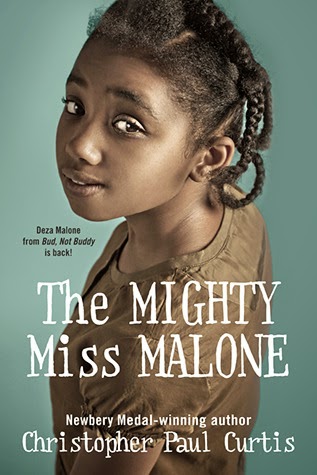
Book Review: The Mighty Miss Malone by Christopher Paul Curtis
Deza Malone lives with her family in Gary, Indiana during the incredibly difficult days of the Great Depression. But despite the turbulence that they are living through, her family remains incredibly close and affectionate, and never loses the optimism that gets them through it all.
Geared toward a younger audience, Curtis tackles issues of poverty and race relations in a way that is gentle enough for kids, but honest enough to be thought provoking. He also elicits a wide range of emotional responses, from the nearly laugh-out-loud funny to the miserably painful.
This was a quick read, and for the most part I enjoyed it. (Yes, even though it's aimed at the younger crowd, there is still enough of a story for the adults.) The main problem I had with the story was the lack of continuity. While the main story arc is about the family's struggle during the Great Depression, there are so many other subplots that just don't pan out, and it made me wonder why they were even there. Things that were laid out like huge, important events that were sure to have a lasting impact on Deza's life were forgotten in the next chapter and never mentioned again. It just struck me as odd.
The thing that kept me reading, despite the continuity problems, was the interaction between the family members. They each had their issues, and the family as a whole had more than its share of problems. But they genuinely cared for each other, and did everything they could to lift each other up. That, for me, made the story worthwhile.
Book Review: The 21-Day Sugar Detox by Diane Sanfilippo
This was an impulse buy, because I saw it on the book table at Costco and I was curious. It turned out to be an interesting (and very quick) read.
In the first section of the book, Sanfilippo starts with a little bit of her personal background, and her struggle with sugar addiction. She then goes through the different types of sugars that we encounter daily, and explains what these sugars do to our bodies, and why it's a good idea to lower our intake of unhealthy foods.
The first section also provides suggestions for how to prepare for the detox. (You can't just decide on a whim to start today. It takes preparation - of your kitchen, and your mental state.) She also gives a look at what you can expect day-to-day during the three weeks of the detox.
The second section of the book provides a meal plan for those who want specific meals laid out for them, and a yes/no foods list for those who want more flexibility. You are perfectly free to create your own recipes, as long as the foods are on the approved list.
The third, and largest, section is filled with recipes, from soups and salads to main dishes, and even snacks and treats. Most of the recipes require a cook that's not quite as lazy as I am in the kitchen, but some of them aren't too complicated.
This book was definitely interesting, and offered some good suggestions. I haven't actually decided yet if I'm going to try the program or not. It sounds like a good idea, but I'm not sure that I have the willpower, especially when I'm also cooking for two kids. (I couldn't expect them to eat that way, and I'm not sure that I have it in me to make separate meals every day.)
Plus, there are two other big things holding me back. One is that you're allowed to drink milk (which I love) but it has to be whole milk (which I'm not sure I could drink. Because... yuck.) The other is that coffee is allowed, but not the creamer. And you already know how I feel about Coffee-mate. I just don't know if I could do it.
Weak excuses, perhaps. But excuses none-the-less. :)
Friday, March 21, 2014
Those Trees! Those Trees! (Those Truffula Trees!)
Every March at my kids' school the kindergarten classes have their annual Dr. Seuss book report parade. The students all make posters, or costumes, or other props to represent their books, and they have a parade through the front office. And trust me when I say that it's just as adorable as it sounds.
This year it was my daughter's turn, and when the assignment came home she immediately said, with a very excited smile, "I want to do The Lorax! Can we make some truffula trees?!" Of course when your six-year-old asks if you can help her make truffula trees, you kind of have to say yes. So to the craft store we went.
And as we wondered around the store, inspiration struck. (Several times, actually.) The plan and the supplies evolved a few times, but we finally came up with a winner.
For the trees: pencils, black paint, yellow ribbon, and feather ornaments. (I had planned to make tissue paper flowers for the tufts, but just happened across these feather things, and they were perfect.)
My daughter loves to paint, so this was her favorite part.
Of course we needed something to hold the trees. So for the base: a plain flower pot, green paint, and a styrofoam insert. (Bonus for me - all of the supplies were fairly inexpensive.)
More painting. (With such concentration!)
And of course we're very proud of our work.
When everything was dry, I helped wrap and glue the ribbon on the pencils.
And used a Sharpie to write the famous quote from the book onto the base.
And with a little bit of hot glue to attache the tufts, we had our truffula trees!
Of course after we were done, we decided that the trees needed to be growing in the grass, and my daughter thought that there should really be some brown barbaloots playing under the trees. So back to the store we went for some shredded paper and chocolate Teddy Grahams. But the extra trip turned out to be totally worth it, because it just made the whole thing that much cuter.
And the end result was one happy little girl and her truffula trees.
Saturday, March 15, 2014
Book Review: Divergent by Veronica Roth
Beatrice Prior lives in a post-apocalyptic society in which people are divided into five factions: Abnegation (the selfless), Amity (the peaceful), Candor (the honest), Dauntless (the brave), and Erudite (the intelligent.) Each faction has their own set of beliefs about what led to the breakdown of society, and has created their own manifestos according what they felt would most benefit people as they moved forward.
When they reach 16, each person is given an aptitude test to help them determine which faction they should belong to. (And while the aptitude test is not a completely necessary part of the process, because each person is free to choose their faction, the testing process does serve to set-up future plot devices.)
While most people's test results show a clear indication of faction aptitude, Beatrice is different. She is labeled Divergent - a person who could equally belong in multiple factions. This label complicates things, of course. Not only can she not discuss it with anyone (or risk great harm, or even death) it also makes her decision that much more difficult.
Being forced to make a choice, she decides to leave her family and her Abnegation upbringing behind and join the Dauntless, a faction that both fascinates and frightens her. What follows is a grueling initiation process in which Beatrice (who now goes by Tris, which she feels is more fitting) must completely reevaluate her beliefs about people and society, all while undergoing intensive combat training and learning to face her deepest fears.
I have to admit that while I love dystopian literature, I resisted this one at first because of all the hype that surrounded it. (I've never been a fan of the overly-hyped trends. Ask my mom. I was the only one of my friends that never wanted a Cabbage Patch Kid.) And I also tend to resist books that come with a "now a major motion picture" label. I can't really explain that one - it just turns me off for some reason.
But my curiosity finally got the better of me, so I decided to give it a shot. And oh... my... goodness. I was hooked! I instantly got sucked into the story, and quickly found myself getting invested in the characters and wanting to know what happened to them. Rather than using manipulative tricks (like Dan Brown's mini-cliffhanger at the end of each chapter) Roth simply created a compelling story that kept me reading. (And reading. And reading.) Seriously. Finishing nearly 500 pages in just over 24 hours kind of illustrates what a page-turner it was for me.
While I highly recommend this book (and can't wait to read the rest of the series) I know not everyone has felt the same way. There are people who say that the plot is too formulaic, or that there are too many plot holes, or that the entire premise is ridiculous. To that, I say:
1) Every genre has a formula, and almost everything ever written will in some way follow it. That's just the way things work. I think we have to learn to get past it, or our reading options are going to be very limited.
2) There are usually plot holes. Authors can't explain everything, and sometimes we just have to fill it in. Or (especially in the case of dystopian novels) sometimes we just have to suspend disbelief and let things go in order to enjoy the story for what it is.
And 3) We're free to agree or disagree with the author's take on the "what if" question of a post-apocalyptic world. But once again, we kind of have to enjoy the story for what it is. Sure, I doubt that society will develop into the factions that Roth imagines. But her story is still an interesting look at human nature, and what a possible future might look like.
Just one more thing (because I said before that I don't like it when authors are super-specific about their settings, and now I have to amend that.) This story is set in Chicago, and does make use of several well-known landmarks. But rather than including a useless series of "I turned left on Third Street and went three blocks before turning right" this story made much better use of specific geography.
Because I have been to many of the settings (like Navy Pier, Millennium Park, and the Sears Tower) I was able to get a better picture of what was happening. (And even if you haven't been to Chicago, the landmarks are fairly well-known, so there's a good chance that you are familiar enough with them to get by.) Most people have at least seen pictures of the giant bean, right?
And if you made it all the way through this ridiculously long review... congratulations! I hope it made you want to go out and pick up a copy of the book.
Have you already read it? What did you think? Please feel free to agree or disagree with my assessment as you see fit. I always value divergent opinions.
See what I did there? ;)
Subscribe to:
Posts (Atom)